Unscreen Yourself Dictionary Definition - Fixed

What Does "Unscreen Yourself" Actually Mean?

EST. 2023
un·screen your·self
| ˌənˈskrēn yôrˈself
[verb]
Definition:
1. To deliberately step away from screens and take back control of your attention.
Example: "I unscreen myself for an hour after dinner—no phone, no laptop, just a puzzle book and tea."
2. To break the habit of letting apps, feeds, and notifications decide how you spend your time.
Example: "She needed to unscreen herself before bed because scrolling was wrecking her sleep."
3. To remember what it feels like when your brain works for you, not for the next viral video.
Example: "Unscreening yourself isn't about rejecting technology—it's about using it on your terms."
Origin Story:
Born in 2023 from a simple realization: we're not really taking breaks from screens—we're just switching from one to another and calling it rest.
Phone to laptop. Laptop to TV. TV to tablet. Back to phone.
We're exhausted, distracted, and barely present with the people right in front of us. Not because we lack willpower, but because every app, feed, and notification is designed to keep us hooked.
"Unscreen Yourself" started as a question about digital wellness: What if there was a simple, offline way to break the cycle? What if we could give people permission to step away—without guilt, without FOMO, without feeling like they're missing out?
The answer: word search puzzles. Not meditation apps that make you feel like you're doing it wrong. Not productivity hacks that add more pressure. Just puzzles that let your brain do what it was designed to do—focus on one thing, solve it, and feel calm while doing it.
That's how you unscreen yourself—one puzzle, one moment at a time. Digital wellness on your terms.
How People Use It:
"Tonight, I'm unscreening myself—no doomscroll, no feeds, no notifications. Just me, a puzzle, and the first real break my brain has had all week."
"I started unscreening for 20 minutes before bed. My sleep is better, my anxiety is lower, and I actually finish books now."
The Problem - Unscreen Yourself Movement
⚠️
THE PROBLEM

Your Attention Is
Under Attack

You're Not Addicted. You're Being Engineered.

Every app on your phone was designed by teams of behavioral psychologists, UX designers, and engineers whose sole job is to keep you engaged. Not happy. Not informed. Not connected.

Just... engaged.

They call it "time on platform." You call it "I can't stop checking my phone."

The scroll never ends. The videos autoplay. The notifications arrive at precisely the moment your attention starts to wander. Red badges appear like little emergencies, begging to be cleared.

It's not an accident. It's by design.

144 times
That's how often the average person checks their phone each day. Once every 7 minutes you're awake.

What This Does to Your Brain

When you're stuck in the scroll, your brain is in a constant state of low-level stress. You're not relaxing. You're not recharging. You're context-switching hundreds of times per hour—news to meme to ad to video to notification to text—and calling it a "break."

Your brain was designed to focus on one thing at a time.

The algorithm trains it to never focus at all.

47 seconds
That's the average time you can work on a task before checking your phone, getting distracted, or switching to something else.
3 hours
Average daily screen time. That's 45 days a year staring at a rectangle.

The result?

  • You can't finish a book without checking your phone
  • You watch entire TV shows without remembering what happened
  • You sit with friends but scroll under the table
  • You promise yourself "just 10 minutes" and lose an hour
  • You feel tired even though you've been "resting" all evening

The "Switching Screens" Trap

You know you need a break from your phone.

So you open your laptop. Then you get bored with the laptop, so you turn on the TV. The TV show feels slow, so you scroll on your phone while watching. Then you pick up your tablet to check something "real quick."

You've been "taking a break" for two hours. But your brain? It's been working overtime the entire time, processing feeds, filtering ads, resisting clickbait, and managing notifications.

That's not rest. That's just screen hopping.

Why Willpower Doesn't Work

You've probably tried deleting apps, setting screen time limits, putting your phone in another room, going on a "digital detox."

None of it sticks. And that's not your fault.

You're fighting a system that's designed to beat willpower. The apps win because they're smarter, faster, and more patient than you are. They have unlimited resources and one goal: keep you engaged.

What You're Actually Losing

It's not just time.

It's the ability to sit with your own thoughts. The feeling of being fully present with someone. The satisfaction of finishing something without distraction. The calm that comes from doing one thing and doing it well.

It's the sleep your brain desperately needs to recover.

It's the moments—small, quiet, beautiful moments—that used to make up your life.

Your brain isn't broken. It's just been hijacked.

The Truth - Trades Section
THE TRUTH

Let's Be Honest—You Know What You're Trading

Every time you reach for your phone, you're making a trade.

Real conversation with someone you love
for a feed of strangers' opinions
Actually finishing that book you started
for 47 TikToks you won't remember tomorrow
Sleep your body desperately needs
for one more scroll through the same content
Being fully present in this moment
for checking what everyone else is doing

YOU KNOW THE TRADE ISN'T WORTH IT.

The algorithm makes it easy to forget.

The way to stop is simpler than you think.

And it doesn't require deleting a single app.

The Solution - Unscreen Yourself Movement
THE SOLUTION

Give Your Brain Something Better to Do

The answer isn't another app. It's not a meditation timer that makes you feel like you're failing. It's not a screen time tracker that just makes you feel guilty.

The answer is surprisingly simple: analog activities that your brain actually wants to do. And here's the thing—word search puzzles are perfect for this.

Why Puzzles Work (And Apps Don't)

Think about the last time you tried to "take a break" with your phone:

You opened a meditation app. It asked you to create an account, choose a subscription, pick a voice, select a background sound, and decide on a session length. By the time you started, you were already stressed.

Or you tried to limit your screen time. Your phone sent you a notification telling you that you've hit your limit... on the phone... that you're still holding... while staring at the screen.

See the problem?

You can't fight screen addiction with more screens.

What Makes Puzzles Different

Word search puzzles work because they give your brain exactly what it needs:

Something to focus on (not 47 tabs)
A clear goal (find the words)
A sense of completion (you finish the puzzle)
🔕 No notifications (the page doesn't buzz)
🚫 No ads (no one is trying to sell you anything)
💭 No guilt (you're not "supposed" to be productive)

Your brain gets to do what it's designed to do: focus on one thing, solve a small problem, and feel satisfied when it's done.

That's it. No login required. No wifi needed. No algorithm deciding what comes next.

THE SCIENCE (BECAUSE IT'S REAL)

When you work on a word search puzzle, your brain enters what researchers call a state of "gentle focus." It's the opposite of the frantic, scattered attention you get from scrolling.

In this state:

  • Your heart rate slows
  • Your stress hormones decrease
  • Your mind stops racing
  • Your attention stabilizes
  • You feel calm without trying to feel calm

This isn't meditation—where you have to "do it right" or you feel like you're failing. This is just your brain doing what it naturally does when you give it something concrete to work on.

Studies show that even 5-10 minutes of this kind of focused, analog activity can reduce anxiety, improve sleep, and help you feel more present for the rest of your day.

Why This Works When Other Things Don't

Here's what makes unscreening yourself with puzzles different from everything else you've tried:

  1. It's not a punishment
    You're not forcing yourself to sit in silence. You're not deleting apps you'll reinstall tomorrow. You're just doing something enjoyable that happens to be screen-free.
  2. It's not another thing to fail at
    Meditation? You're "doing it wrong." Digital detox? You lasted 6 hours. Puzzles? You just do them. There's no way to fail.
  3. It doesn't require willpower
    You're not resisting the urge to check your phone—you're genuinely occupied with something else. Your brain isn't fighting the scroll; it's engaged in something better.
  4. It fits into real life
    You don't need a special room, a yoga mat, or 45 uninterrupted minutes. Puzzles work on the couch, at the kitchen table, in the airport gate, or for 10 minutes before bed.
  5. You actually feel better afterward
    Scroll for an hour? You feel worse. Do a puzzle for 20 minutes? You feel calmer, sharper, more like yourself.

Let's be clear: we're not saying technology is evil or that you should throw your phone in a river.

Screens aren't the enemy. The problem is that we've lost control of how and when we use them.

Unscreening yourself isn't about rejecting technology—it's about using it on your terms. It's about having moments in your day where the algorithm doesn't get to decide what you pay attention to.

It's about remembering that you can put the phone down, pick up something analog, and give your brain the kind of break it actually needs.

The Bottom Line

Your brain deserves better than the algorithm.

Word search puzzles are how you give it exactly that—one page, one puzzle, one moment of calm at a time.

No apps. No guilt. No trying to be perfect.
Just you, a puzzle, and your brain doing what it was meant to do.

How to Start - Unscreen Yourself Movement

How to Start Unscreening Yourself

You don't need to overhaul your entire life. You don't need to delete Instagram, throw away your phone, or commit to a 30-day digital detox.

You just need to start small. Here's how:

Step 1

Pick One Time, One Place

Don't try to unscreen "all the time." That's how you burn out and give up by day three.

Instead, pick ONE specific time when you'll do a puzzle:

  • Right after dinner (before the evening scroll starts)
  • First thing in the morning (before checking your phone)
  • Before bed (instead of doom-scrolling until midnight)
  • During your lunch break (actual break, not phone break)
  • Sunday mornings (coffee + puzzle = perfect)

And pick ONE place where the puzzle lives:

  • Kitchen table
  • Nightstand
  • Coffee table
  • Your work bag
  • Next to the couch

Make it easy. If the puzzle book is right there and your phone is in another room, you'll reach for the puzzle.

Step 2

Start with 10 Minutes

Not an hour. Not "until you finish the whole book."

Just 10 minutes.

That's it. One puzzle. Maybe not even a whole puzzle if it's a tough one.

Ten minutes is:

  • Short enough that you won't talk yourself out of it
  • Long enough for your brain to shift out of screen mode
  • Easy to fit into any day, no matter how busy

If you want to keep going after 10 minutes? Great. If not? You still unscreened yourself. That's a win.

Step 3

Put Your Phone Somewhere Else

This is non-negotiable.

If your phone is next to you while you're doing a puzzle, you'll check it. We all do. It buzzes, you look. It doesn't buzz, you still look.

So put it in another room. Or face-down across the room. Or in a drawer. Somewhere you can't see it or hear it.

You're not deleting apps. You're not turning it off forever.

You're just giving yourself 10 minutes where the phone isn't the main character.

Step 4

Don't Make It Productive

Here's the part people mess up: they turn unscreening into another self-improvement project.

"I'll do puzzles to get smarter!"
"I'll track my progress and optimize my puzzle-solving time!"
"I'll set goals and measure my focus improvement!"

No. Stop. That's just more pressure.

This isn't about being productive. It's about giving your brain permission to do something for no reason other than it feels good.

You're not training for anything. You're not fixing yourself. You're just… unscreening.

The 7-Day Unscreen Challenge

Want a simple way to start? Try this:

Day 1
Do one puzzle. Any puzzle. 10 minutes. That's it.
Day 2
Same time, same place. 10 minutes. Notice how your brain feels different than when you're scrolling.
Day 3
Put your phone in another room first. See if it's easier to stay focused.
Day 4
If you're tempted to check your phone, just notice the urge. You don't have to fight it—just see it and go back to the puzzle.
Day 5
Try doing a puzzle at a different time of day. Morning? Evening? Lunch break? Find what fits.
Day 6
Notice what you're NOT doing while you're doing the puzzle. Not scrolling. Not checking. Not context-switching 47 times a minute.
Day 7
Check in with yourself. Do you feel different? Calmer? More present? Less pulled toward your phone?

After 7 days, you'll know if this works for you. And chances are, you won't want to stop.

What to Expect

Here's what usually happens when people start unscreening:

Days 1-3: It feels weird

Your brain is used to constant stimulation. Sitting with a puzzle and nothing else? It'll feel slow at first. You might get antsy. You might want to check your phone "real quick."

That's normal. Your brain is detoxing from the scroll. Keep going.

Days 4-7: It starts to feel good

Somewhere around day 4 or 5, something shifts. The puzzle stops feeling like work and starts feeling like relief. You look forward to it. You might even catch yourself thinking, "I don't want to check my phone right now. I just want to finish this puzzle."

That's the moment you know it's working.

Week 2 and beyond: It becomes a habit

By week two, unscreening isn't something you "should" do—it's something you want to do. It's the part of your day where you actually feel calm. Where your brain gets to rest.

And here's the best part: you'll start noticing that you reach for your phone less overall. Not because you're forcing yourself to resist, but because your brain remembered what it's like to focus on something real.

Tips for Making It Stick

  • Keep the puzzle book visible - If it's buried in a drawer, you'll forget about it.
  • Pair it with something you already do - Coffee? Puzzle. Lunch? Puzzle. Before bed? Puzzle.
  • Don't beat yourself up if you miss a day - This isn't about perfection. Just pick it back up tomorrow.
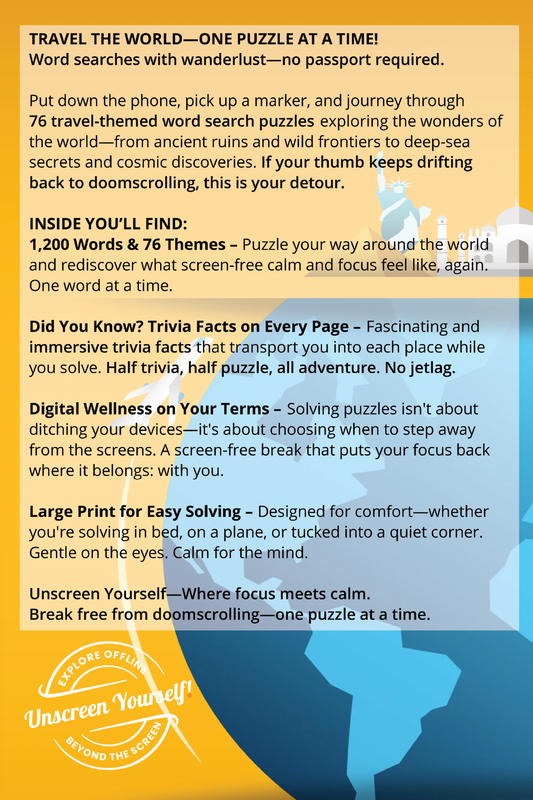
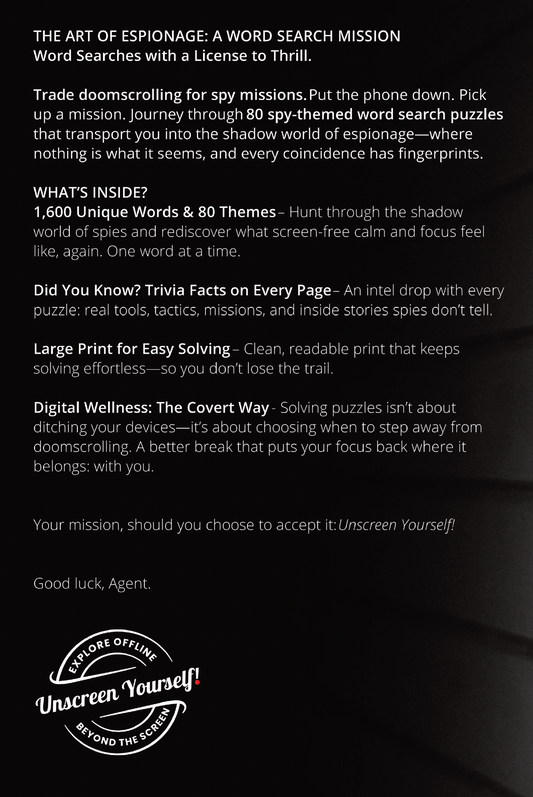
  • Try different puzzle books - If one theme doesn't grab you, try another. Travel? Espionage? Pop culture? Find what you actually enjoy.
  • Tell someone you're doing this - "I'm unscreening for 10 minutes after dinner" makes it more likely you'll actually do it.

You Don't Need Permission, But Here It Is Anyway

You're allowed to take 10 minutes where you're not productive, not optimizing, not improving.

You're allowed to do something just because it feels good.

You're allowed to put your phone down and not feel guilty about it.

Start today. One puzzle. 10 minutes.
Unscreen Yourself!

FAQ - Unscreen Yourself Movement

Questions You Might Have

Yes. These aren't difficult puzzles—they're designed to be relaxing, not stressful. If you can read, you can do these puzzles. And honestly, being "good" at them isn't the point.

The point is giving your brain something to focus on that isn't a screen. You're not being graded. You're just unscreening yourself.

Meditation apps are great—if they work for you. But a lot of people try them and end up feeling like they're "doing it wrong" or can't quiet their mind enough.

Word search puzzles work differently. You're not trying to clear your mind. You're giving your brain something concrete to do—scan, search, find. Your mind naturally quiets down because it's focused on the task, not because you're forcing it to be still.

Plus, puzzles are offline. You're not using a screen to take a break from screens.

You have time to scroll for 20 minutes, right?

This isn't about finding "extra" time. It's about replacing scrolling time with something that actually helps your brain rest.

Ten minutes. That's it. If you can scroll through Instagram for 10 minutes, you have time to do a puzzle.

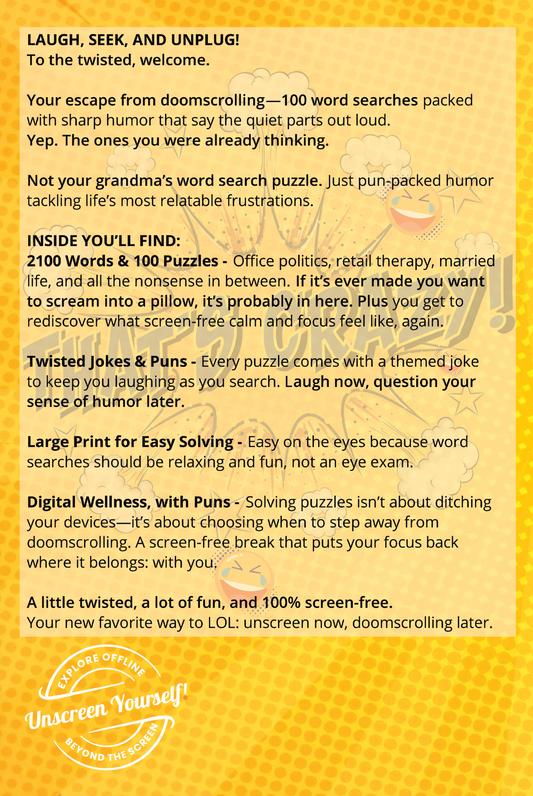
If you get bored with one theme, try a different one. We have espionage, travel, pop culture, puns—pick what interests you.

And honestly? If you're used to TikTok and infinite scroll, anything that's not constantly changing will feel "boring" at first. That's your brain detoxing from overstimulation.

Give it a few days. The boredom fades, and what replaces it is something better: calm.

Absolutely. A lot of parents use puzzle time as a screen-free family activity. Everyone grabs a puzzle book, sits at the table, and works on their own puzzles together.

No fighting over whose turn it is on the iPad. No "just five more minutes" arguments. Just quiet, focused time where everyone's brain gets a break.

You could delete all your apps. Some people do. But most people can't or won't—social media is how they stay connected to friends, family, work, and the world.

Unscreening yourself isn't about deleting everything and going off the grid. It's about having moments in your day where screens don't control your attention.

You don't have to choose between "all screens" or "no screens." You can have both—on your terms.

You probably will, at first. That's normal.

Keep the puzzle book somewhere visible—on your nightstand, on the coffee table, in your bag. The more you see it, the more likely you'll remember to pick it up instead of your phone.

If you miss a day, don't beat yourself up. Just start again tomorrow. This isn't about perfection. It's about progress.

Nope. Do as many or as few puzzles as you want.

Some people finish a book in a month. Some take six months. Some jump around to different themes based on their mood.

There's no deadline. There's no requirement. The book is yours—use it however works for you.

It's not therapy. It's not medication. It's not a cure for anxiety or depression.

But here's what it can do: give your brain regular moments of calm, focus, and rest. Over time, those moments add up.

A lot of people report sleeping better, feeling less anxious, and being more present with the people around them after they start unscreening regularly.

Will it fix everything? No. Will it help? For most people, yes.

Perfect. Do those.

Unscreening yourself isn't limited to puzzles. It's about any offline activity that gives your brain a real break.

Puzzles just happen to be:

  • Easy to start (no setup required)
  • Portable (fits in your bag)
  • Quick (10 minutes works)
  • Engaging (your brain doesn't wander back to your phone)

But if reading, knitting, or walking works better for you? Go for it. The movement is about getting off screens and being present—however that looks for you.

A puzzle book alone won't magically fix your relationship with your phone.

But here's what it does: it gives you an alternative. When you're reaching for your phone out of habit or boredom, you have something else to reach for instead.

Over time, that builds a new habit. Instead of "I'm bored, let me scroll," it becomes "I'm bored, let me do a puzzle."

Small changes, repeated daily, create big shifts over time.

Still have questions?

Good. That's what we're here for.

We love hearing from you...

Ask Us Anything →